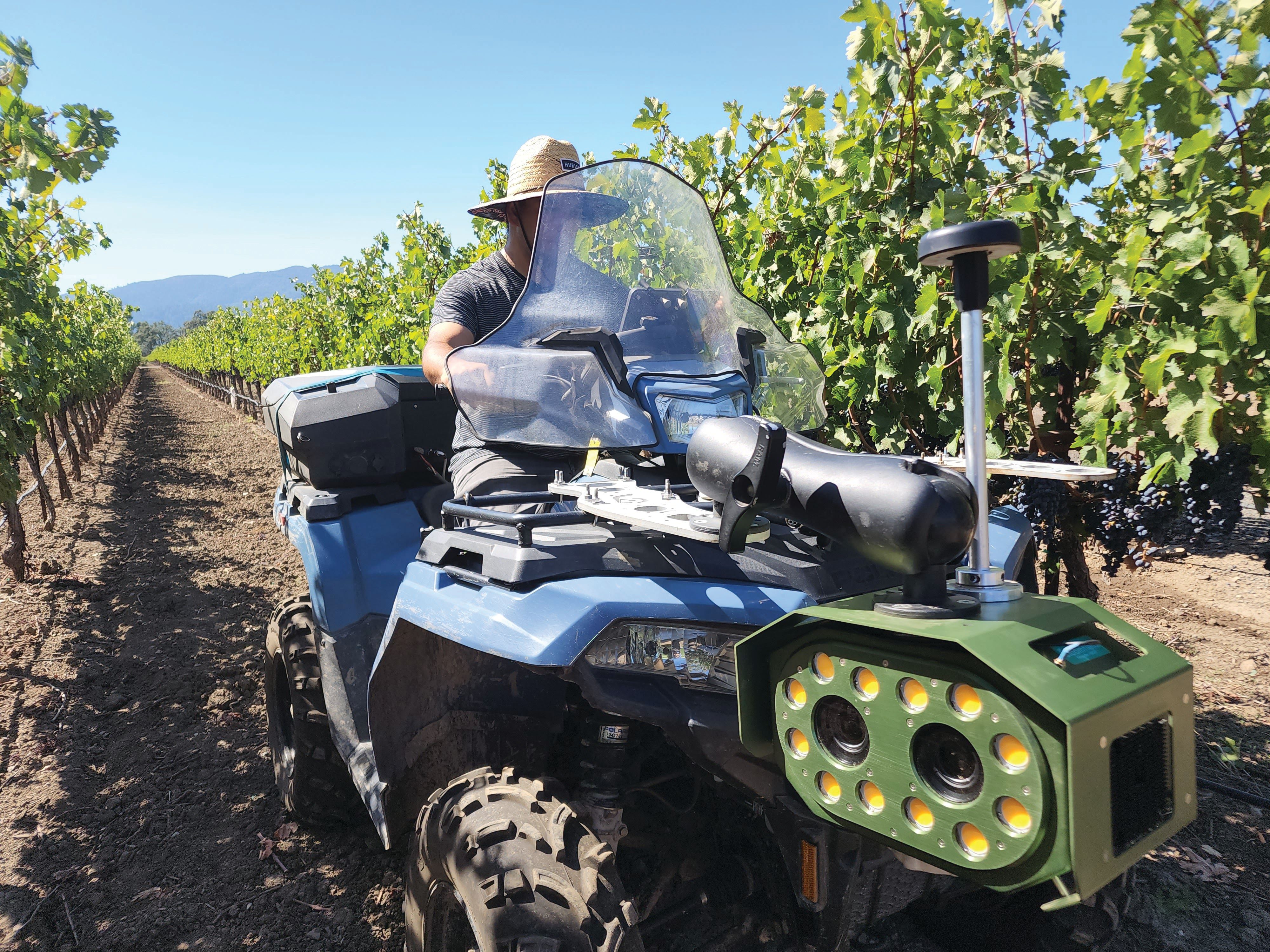
Artificial intelligence has been a game changer in recent years for a wide variety of industries, so it's no surprise that AI tools are transforming crop management as well.
Farmers are now leveraging advanced technologies such as drone surveillance, predictive analytics and automated irrigation systems to optimize crop health and increase yields. These groundbreaking innovations not only improve efficiency but also reduce water usage and pesticide application, making orchards more sustainable.
That's why growers are optimistic that embracing AI-driven solutions will help them meet growing demand while protecting the environment, signaling a new era of smart farming in the industry.
Across California's orchards and vineyards, companies developing vision systems, autonomous vehicles and aerial imaging platforms are racing to prove that their tools can handle the complexity, variability and scrutiny that come with high-value crops. The technology is advancing quickly, but so is the demand for transparency about how well AI performs.
The Road to Reliability
The International Fresh Produce Association has tracked the shift from experimental pilots to commercially deployed AI systems across specialty crops.
"AI is moving from hype to application," said Sarah Gonzalez, director of communications and public affairs for International Fresh Produce Association. "Farm-level uses range from vision systems and robotics to genomics-assisted breeding and quality assurance."
Part of that shift is tied to the mainstream adoption of biological inputs, which have gone mainstream in recent years.
"This is an area being shaped heavily by data and automation," Gonzalez said. "Biological inputs are used by roughly two-thirds of specialty crop growers to boost quality, stabilize yields and meet tightening residue limits."
IFPA expects 2026 to bring more clarity and more consistency to how AI and biologicals work together. Standardized programs, better spore-trap analytics and the rise of AI scouting are giving growers earlier indicators of potential issues and enabling more precise interventions.
We are asking these businesses to entirely change the way they collect and consume a data source that is used to run the entire operation.— Hayden Wolf, CEO, Bloomfield Robotics
"Leading growers are redesigning fields for automation and pairing AI scouting with biologicals to enable earlier, lighter interventions," Gonzalez said. "The results are improved quality, reduced inputs and stronger sustainability claims for buyers."
In tree nuts and other orchard systems, autonomous machinery is becoming more common.
"In California's orchards, autonomous systems for shaking, harvesting and in-row navigation are gaining investment," Gonzalez said. "And for berries and soft fruit, robotic harvesters are entering commercial use, often with human crews providing quality checks."
But field-level AI still faces variability across crops, canopy architecture, microclimates and operations, which makes reliability as much a design challenge as a technological one.
Plant-Level AI
The reliability of AI ultimately comes down to what is being measured and how consistently.
That's where Pittsburgh-based Bloomfield Robotics comes in. The company uses AI-powered imaging to deliver continuous, plant-level insights on fruit size, color, disease and canopy health.
"We use AI to measure what we see in an image taken by our devices: how many oranges do we see, what is the color of that blueberry, what is the size of that grape, etc.," said Hayden Wolf, CEO of the company. "Performance can be measured against human counts in the images or against final harvest numbers."
But the human benchmark is not always as solid as growers assume.
"People have a hard time admitting this, but humans aren't even very good at ground truthing," Wolf said. "It's difficult work, it's repetitive, and it's hard to verify if the work was done correctly or done at all."
Bloomfield Robotics' models perform best where the business has focused its engineering resources, currently blueberries, grapes and citrus, which continue to evolve as new datasets accumulate. Even variability in trellis systems is surmountable, Wolf said.
He noted that adjusting to new conditions is often a simple workflow shift, not a major algorithm overhaul.
"A good example of site variability affecting additional calibration would be in grape trellising where you point the cameras up instead of horizontally, so it's a five-minute fix," Wolf said.
The real hurdle is not whether the AI works. It's whether the grower's organization is ready for the transformation that comes with plant-level digitization.
"We have some customers that trial for six weeks and make a commitment to move to 100% coverage inside of the same season, but we also have customers who we have been working with for more than three years," Wolf said. "We are asking these businesses to entirely change the way they collect and consume a data source that is used to run the entire operation."
The company's philosophy is that AI's value lies in precise assessment, not predictions that claim too much.
"We've learned that customers are willing to pay for an excellent picture of the present, and so that is what we focus on."
Looking ahead, Wolf sees major progress in assessment and analysis but noted true robotic execution is still developing.
"There is no way to replace the intimate knowledge a grower has of their production, but the key is to figure out how to incorporate that into the AI decision-making process," he said.
Imagery, Autonomy and the Path to Scale
The AI orchard ecosystem is broad, and autonomy companies are pushing reliability forward in a different dimension with consistent, safe execution of physical tasks.
Bonsai Robotics, which specializes in vision-based autonomy for vineyards, is building systems that can navigate dusty rows, changing terrain and fragile crops like table grapes.
"For grape growers, this means reliable automation that enhances efficiency and consistency in day-to-day tasks like hauling, spraying and mowing," said Joanna Normoyle, product and program manager for the Woodland, Calif.-based company. "Grapes require gentle handling and precise navigation to avoid damaging fruit and vines. Our system's advanced perception allows for safe operation in tight vineyard rows and minimizes crop impact."
Autonomy is expensive to deploy, but rapid payback is becoming a selling point. Normoyle noted growers typically recoup costs quickly.
"The efficiencies gained can begin offsetting upfront costs immediately, especially in times of labor shortages," she said.
The company is currently running commercial trials for spraying, weeding, mowing and harvest logistics, all core pressure points in California vineyards.
Aerial AI
Aerial AI adds another layer of reliability by giving growers a top-down understanding of plant stress, nutrient issues and irrigation uniformity at scale.
San Francisco-based Ceres Imaging has AI systems to help global farming enterprises protect yield and increase resource-use efficiency.
"Ceres' insights are rooted in over a decade of high-resolution aerial imagery, proprietary sensors and ground-truth data," said Anubhav Sharma, head of marketing for the company. "Our AI models are trained and validated on more than 17 billion plant-level measurements."
Collaborations with UC Davis and major agribusinesses have strengthened those models across millions of acres.
Sharma noted that imagery doesn't replace field measurements, it amplifies them.
"Imagery shows where to look and how widespread the issue is," he said. "Probes, pressure tests and scouting confirm why it's happening and how to fix it."
The company also integrates confidence layers into every map so growers know how much trust to place in a given insight.
"Each map is delivered with metadata that includes signal quality and model confidence," Sharma said. "That transparency can support decisions ranging from irrigation adjustments to risk assessment for insurers and lenders."
Ceres performs most consistently in almonds, pistachios, walnuts and grapes — high-value perennial crops where canopy structure is stable and data volume is deep.
"We serve more than 30% of California tree nut growers," Sharma said, noting that the biggest accuracy challenges occur in newly planted blocks, highly variable canopies or areas with heavy weed pressure.
The Road Ahead
The reliability of AI in orchard management is steadily improving, but according to Gonzalez, the nature of the technology means it succeeds most when paired with human expertise, consistent data flow and clear expectations about what AI can and cannot do.
"Growers want accurate, timely information, and AI is pushing the industry closer to plant-level, real-time intelligence," she said. "But they also want reassurance that the insights they receive are trustworthy, transparent and operationally relevant."