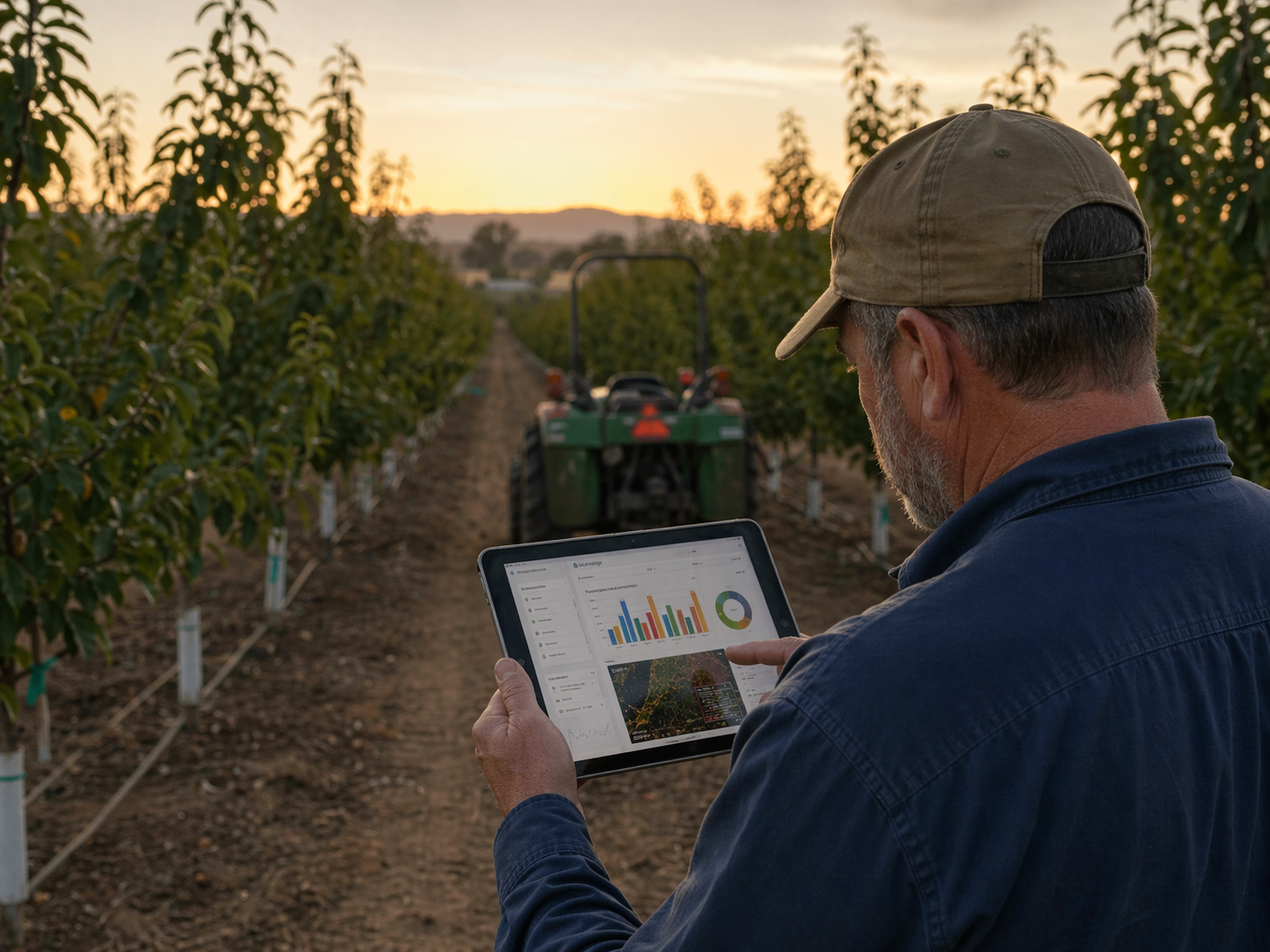
Ask any enterprise-scale grower where their biggest operational blind spot is, and the answer almost always points to the same place: the distance between what they can see with their eyes and what’s actually happening across every acre they farm. The difference matters more each year.
Permanent crops change this equation in a way annual row crops never had to reckon with. A walnut block planted today is a thirty-year asset. The decisions made in its first five years — rootstock, spacing, irrigation design, nitrogen program — compound over decades. If you’re managing six such blocks across three counties, the sample size of your own experience isn’t enough to tell you which decisions actually worked.
This is where the absence of data shows up as real money. Lenders want portfolio-level performance reports they can price against. Landlords want per-block yield history before they renegotiate. Buyers want consistent quality documented over time. Traditional operation — the binder of spreadsheets, the walk-the-block memory of a veteran foreman — can’t produce these artifacts on demand.
“We’re running a business that lives on thirty-year horizons with data that barely survives the season.”
The shift is operational, not technological
The technology piece is increasingly solved. Sensors, satellite imagery, drone flights, yield-mapped harvest equipment all generate the numbers. The operational piece is harder. Most enterprise operations weren’t built to consume telemetry. They were built to run crews, move water, and keep the trucks on time.
The operators pulling ahead of the field have done three things. First: they own the data instead of letting it live in a vendor portal they can’t export from. Second: they’ve assigned someone — usually a single data-literate manager — whose job is to turn raw telemetry into a weekly operating report that leadership actually reads. Third: they’ve made the data a routine part of buying decisions, not a separate exercise for off-season planning.
An edge that compounds
None of that requires a new org chart or a seven-figure software purchase. It requires treating information as an asset class the business already owns, rather than a downstream artifact of operations. The growers who get that right have an edge that compounds — and unlike most edges in this industry, it’s one nobody can copy overnight.
We’ll be running more pieces in this vein across the year. If you’re building a data practice inside an enterprise operation and want to compare notes, the door is open.