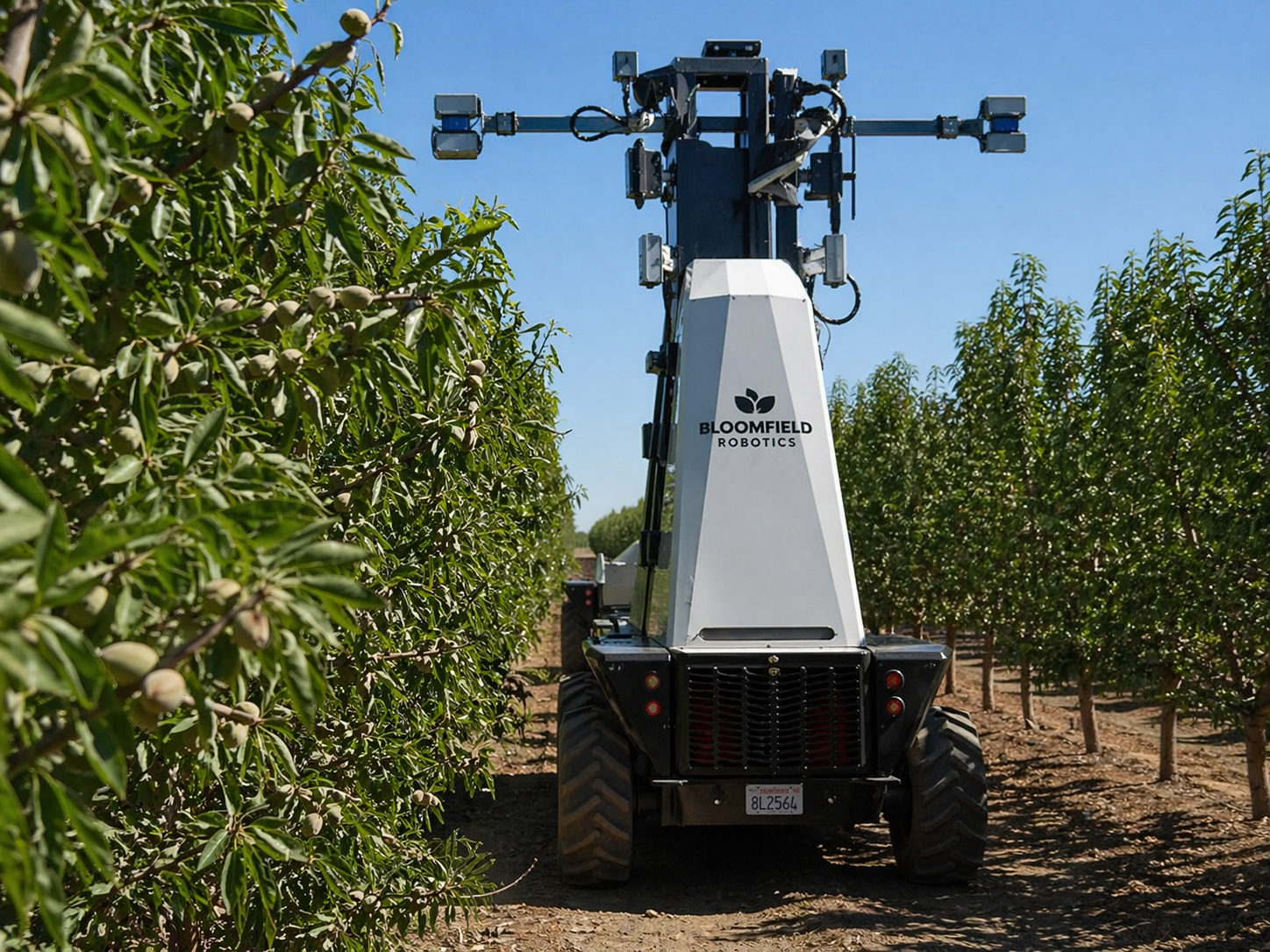
For California’s largest orchard operators, the hardest decisions have always come down to data they didn’t have. How is each block actually performing? Which trees are under stress? Where is the next replant already overdue? A new generation of AI-powered sensor platforms is starting to answer those questions at a precision that changes how enterprise-scale operations plan, hire, and buy.
Bloomfield Robotics — whose tower-mounted camera rig is featured on this issue’s cover — is one of a handful of companies putting computer-vision hardware directly into the canopy. The rig traverses a vineyard or orchard at tractor speed, capturing per-vine imagery under controlled lighting. What used to take scouts days of visual inspection now generates a continuous record that software can analyze overnight.
The data that falls out of a single pass is what matters. Tree count. Canopy health. Fruit load. Disease pressure by row. For a 2,000-acre almond operation, the difference between spraying every block on a calendar and treating only the 14% showing early stress is measurable in hundreds of thousands of dollars of product — before you count the labor, the diesel, and the compaction.
“We’re not trying to replace the crew. We’re trying to give them a map.”
Why now, not five years ago
The economics have finally caught up to the technology. Five years ago a sensor platform cost more per acre than the lift in yield could justify outside of high-margin wine grapes. Today, the combination of cheaper cameras, better edge compute, and a labor market that makes every human hour more expensive has shifted the math for commodity permanent crops — almonds, pistachios, walnuts, table grapes.
For enterprise operators, the real change is upstream of the field. When a grower can quantify canopy-level performance across every block they farm, the conversations with input suppliers, PCAs, and landlords change. You stop buying products on brand and start buying them on what the data says worked. You stop renewing the underperforming lease because you can prove it’s underperforming.
What it means for the industry
None of this is a silver bullet — the operators deploying these tools are clear that interpretation still lives with the agronomist, not the algorithm. But for the grower who manages multiple permanent crops across multiple counties, AI-enabled sensing is rapidly becoming the baseline, not the edge. The question is no longer whether to deploy. It’s which platform, on which blocks, and how quickly you can train your team to act on what it tells them.
We’ll be covering specific deployments — the hardware, the vendors, the outcomes — in future issues. If your operation is running one of these platforms and would be open to a conversation, reach out to the editor.